Back & sacroiliac pain
Kissing spines, sacroiliac dysfunction and thoracolumbar tension: the most common reason a horse stops working over its back.
Equine Service · Yard Visits
Assessment, hands-on treatment and a staged return-to-work plan, carried out at your yard, for horses in rehabilitation, horses that have lost their straightness, and horses you want to keep sound in work.
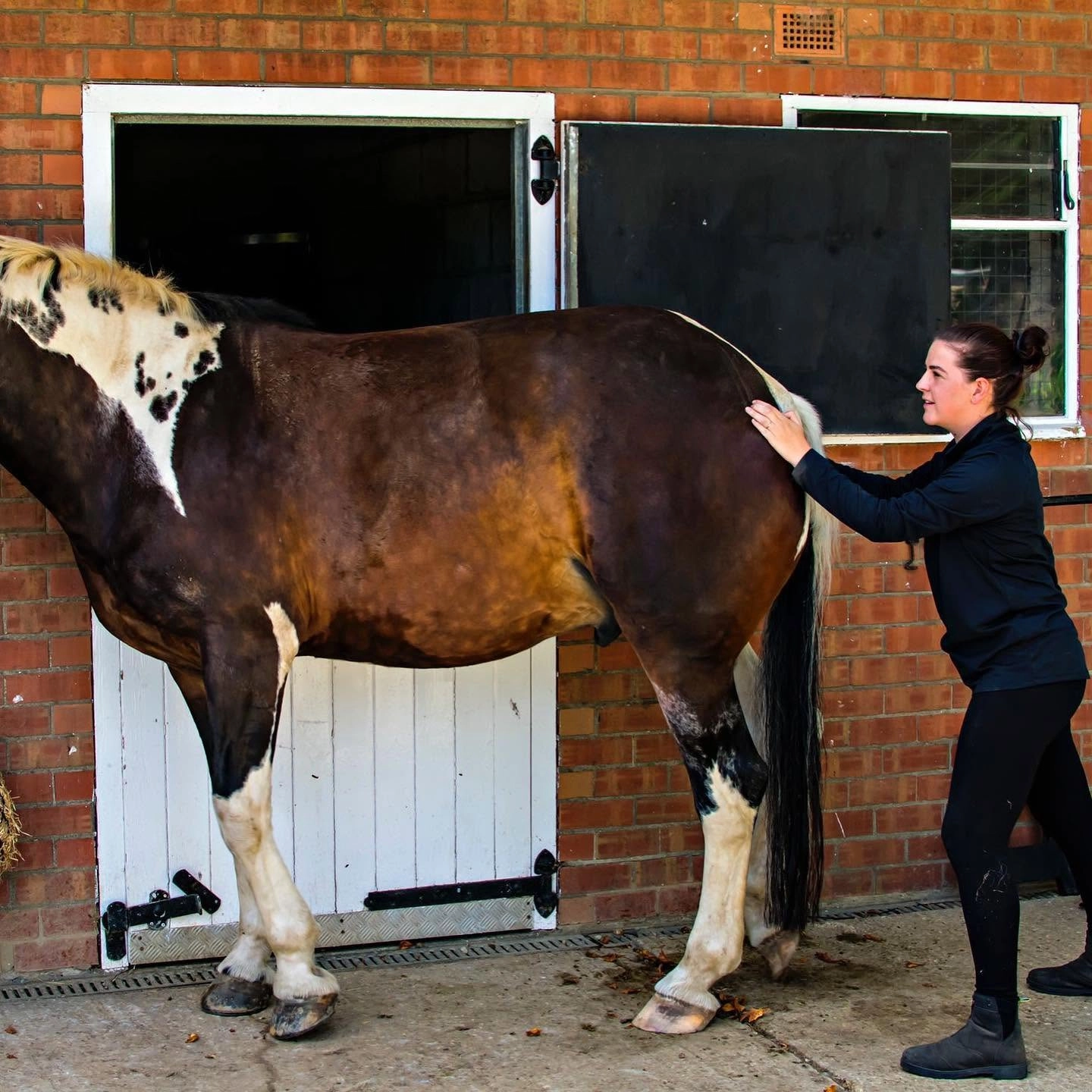
Most horses arrive with a performance problem rather than a diagnosis: a change of contact, a lost canter lead, a horse that no longer wants to go forward. These are the patterns behind it.
Kissing spines, sacroiliac dysfunction and thoracolumbar tension: the most common reason a horse stops working over its back.
Suspensory desmitis, superficial digital flexor injury and check ligament strain, rehabilitated alongside your vet's imaging timeline.
A staged walking and strengthening programme that rebuilds topline and core control before ridden work resumes.
One-sided contact, a difficult rein and a preferred canter lead. Often muscular and compensatory rather than lame.
Competition horses in eventing, dressage and showjumping: symmetry screening, recovery between runs, and off-season conditioning.
Keeping older horses comfortable in light work or retirement, with maintenance treatment and turnout-based exercise.
Interactive 3D Guide
An interactive 3D model of the areas treated most often: neck, shoulder, thoracic and lumbar back, pelvis, gluteals, hamstrings, stifle and lower limb. Select any area to see the signs owners tend to notice first, and how physiotherapy helps.
Explore the horse in 3DTechniques
Conformation and muscle symmetry standing, then in-hand on a straight line, on the circle, and ridden where the question is a ridden one.
Soft tissue release, joint mobilisation and stretching, alongside WINBACK tecar, laser therapy and PEMFT where indicated. Megan is a certified WINBACK specialist. More on our techniques →
Pole work, hill work, in-hand lateral work and core activation, written as a weekly plan you can hand to whoever rides the horse.
Physiotherapy will not hold if saddle fit, foot balance or dentistry is working against it. We report back to your vet and liaise with your saddle fitter and farrier where it matters.
Sessions & Fees
Most UK insurance policies cover veterinary physiotherapy on referral. We provide itemised invoices and a written report for every claim.
Initial Physiotherapy Consultation & Treatment
Approx. 90 minutes at your yard
£75
Maintenance Physiotherapy Treatment
Approx. 60 minutes, including plan progression
£65
WINBACK Tecar Therapy (single area)
Requires a full gait analysis and assessment first
£45
Additional Tecar Therapy
Per extra area treated in the same session
£10
Gait Analysis & Assessment
Required before any WINBACK tecar therapy begins
£25
Block of WINBACK Tecar Sessions
Multiple sessions booked together
POA
All horses must undergo a full gait analysis and assessment before WINBACK tecar therapy begins. A multi-horse discount is available for five or more horses at the same yard. Visits within 25 miles of Scarborough are included; mileage charges may apply to visits beyond that radius.
Common Questions
If your question is not here, call and ask. It is usually faster than filling in a form.
07817 001834Yes. Veterinary consent is a legal requirement before a horse can be treated by a physiotherapist. Send us your practice details and we request it on your behalf; it usually takes a day or two.
That depends on the diagnosis and your vet's rehabilitation plan. Most horses continue in light work through treatment; return to full work is staged and reviewed at each visit rather than fixed in advance.
A dry, level area to assess in-hand, a straight run of about 30 metres, and a clean, dry horse. A school or a flat yard surface is ideal. If you want a ridden assessment, have the horse tacked up and a rider available.
Regularly. Physiotherapy will not hold if saddle fit or foot balance is working against it, so we liaise with your team where it is relevant and say so plainly when something outside physiotherapy needs addressing.
Most UK policies cover veterinary physiotherapy when it is carried out on veterinary referral. We provide itemised invoices and treatment reports for your claim, and can send them directly to your insurer.
Yes. Equine work is almost always done at the yard. Visits within 25 miles of Scarborough are included in the session fee, and mileage charges may apply to visits beyond that radius. We group yards by area where we can, so ask which day we are usually near you.
A first conversation costs nothing and will tell you whether an assessment is worth booking.
Contact MC Veterinary Physiotherapy